

Where to find it
Wren is available in two places:- Full screen: the Wren home screen, with prompt suggestions grouped by Build, Test, Ask, and Analyze. Best for starting a build session.
- Side panel: open Wren as a side panel from anywhere in Agent Studio to start a new conversation or pick up an existing one without leaving the page you’re on. Useful for asking a question or making a quick change while you’re working in Flows, Testing, or any other section. Toggle it with ⌘+I (Ctrl+I on Windows).
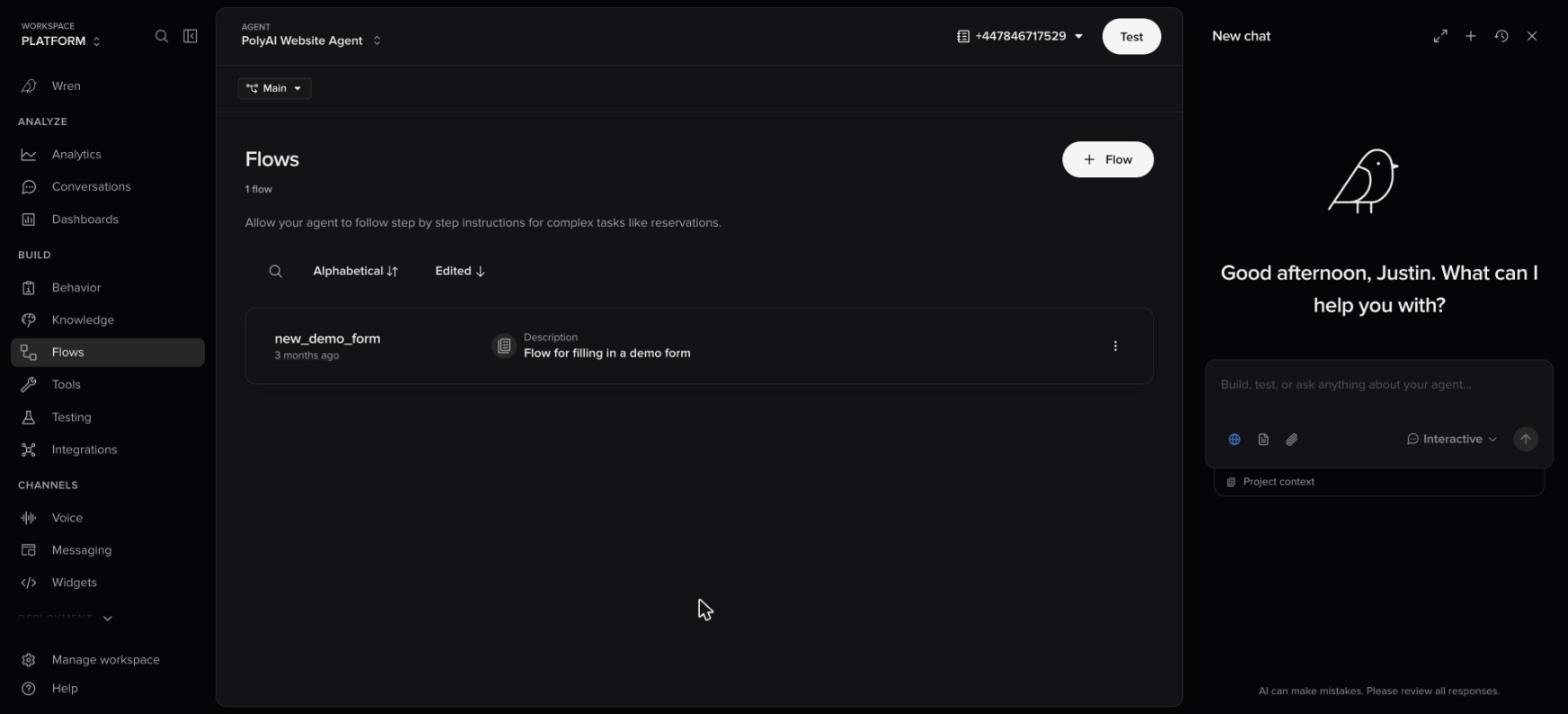
Wren's side panel open over Flows, with the page still usable alongside it
What you can do
Wren’s prompt suggestions are grouped into four intents. They’re a good mental model for what to ask.Build
Create and edit flows, topics, entities, functions, integrations, handoffs, behavior, and agent settings.
Test
Generate simulation test scenarios, write and run test cases, and review results.
Ask
Ask questions about your project config, debug production issues, and explore PolyAI concepts.
Analyze
Investigate performance patterns, conversation trends, and caller behavior across real calls.
Build and edit
Wren operates on the same building blocks you’d edit by hand: flows, topics, entities, functions, handoffs, behavior, channel settings, and more. It can read your current config, propose changes, and write them to a Branch. See everything Wren can build → Wren is channel-aware: on chat projects it pulls in chat-specific guidance (message length, formatting, async turn-taking); on voice projects it stays voice-first. The plan-and-approve workflow is identical across channels.Test
Wren can author, run, and manage simulation tests directly from chat. Ask it to generate test scenarios for a flow, and the cases land in the Simulation Tests workspace alongside anything you’ve saved by hand. It updates test cases as the underlying flows and topics change. Ask it something like “Add simulation tests for the refund flow, including the 30-day cutoff”. See the prompting guide for more examples. Test cases Wren writes are tagged Wren Autofix in your test suite, so you can always tell them apart from cases you wrote yourself.Ask and debug
Beyond answering questions about your project (“what does this flow do?”, “which functions referenceaccount_lookup?”), Wren can debug production conversations. Give it a conversation ID or describe a caller issue, and it walks through:
- Step-by-step timings for each turn
- Latency breakdown and model behavior
- Tool calls and their responses
- Where and why calls dropped or handed off
Analyze
Ask natural-language questions about your agent’s conversations, like “What’s causing handoffs?” or “How did my agent perform this week?”, and get answers backed by transcript sampling across hundreds of real conversations, with charts generated inline. Analyze conversations →How changes work
Plan and approve
When you ask for a change, Wren proposes a plan. Nothing is written until you approve. Expand the plan to see the full breakdown, or choose Revise to send feedback and have it re-planned. Once you approve, every applied edit produces a summary card you can inspect.Interactive and Auto
Wren runs in one of two modes, chosen from the composer: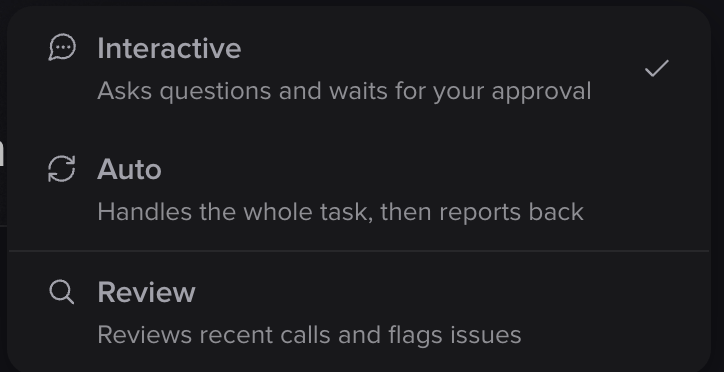
Switching between Interactive and Auto from the composer
Branches
The first time you ask for a change, Wren checks your open Branches. If one already covers the request, it carries on there. Otherwise it creates a new Branch from Live, named after the request and prefixedwren/. Either way, Live stays untouched.
Wren never publishes on its own. When you’re ready, you publish the Branch to Live yourself with the Publish button in the top-right corner. The one exception is an experiment. If you ask, Wren can start, re-split or end one, but it always asks you to approve first. Ending an experiment with your Branch as the winner merges that Branch onto Live.
What it won’t do
- Edit anything other than your Branch. It never publishes to Live or moves a Branch to Staging, and it can’t change Live directly.
- Access other projects. Wren is scoped to the project you’re in.
Who can use it
Wren is available to everyone with access to a project. What you can do depends on your permissions:- Edit access: build, modify, test, branch, and apply changes.
- Read-only access: ask questions, explore the project, investigate calls, and analyze conversations. Wren won’t start a build or write to a Branch, and will say so rather than working around it.
Limits
Wren has a fair-use limit so usage stays predictable. If you reach it, Wren pauses until the next reset and tells you when that is. Manual editing in Studio still works normally. Usage and limits →See it in action
New to Wren? The walkthrough runs one build end to end, from first prompt to published Branch, with screenshots at every step.A full session, step by step
Describe a change, answer the questions, approve the plan, review what changed, publish.
Keyboard shortcuts
Disclaimer
AI can make mistakes. Please review all responses.Every change Wren makes appears on your Branch just like a manual edit. Inspect it, tweak it, or revert it before publishing.
Related pages
Prompting guide
Patterns for getting consistently good results.
What Wren can build
Every building block Wren can create and edit.
Analyze conversations
Ask questions about real calls and get answers backed by transcripts.
Chats and context
History, attachments, voice input, and project context.
Usage and limits
Your fair-use allowance, reset cadence, and what to do when you hit it.