
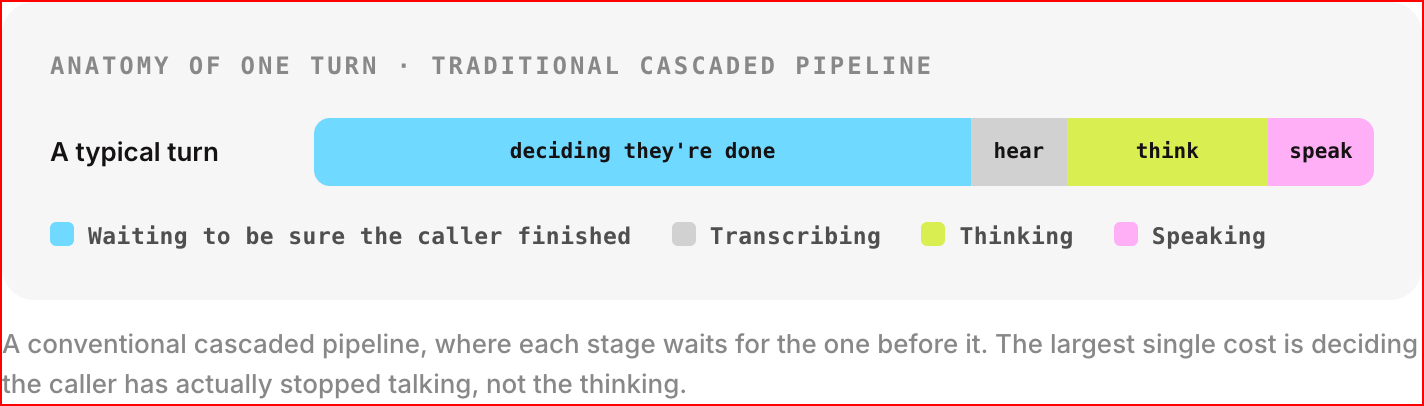
A conventional cascaded pipeline, where each stage waits for the one before it. The largest single cost is deciding the caller has stopped talking, well ahead of the thinking stage that follows.
Why it’s built this way
A conventional voice pipeline runs speech recognition, then a language model, then speech synthesis, each stage waiting for the one before it to finish. Each stage adds delay, and each transcript handoff drops what the audio carried beyond the words: tone, and the sound of someone still deciding what to say. Dialog-RSN-1 collapses the first two stages into one model. It hears the call and answers it in one pass, with no transcript handoff in between. It also spends thinking time per turn rather than on a fixed schedule, so a simple question stays fast. By default the API speaks the reply. Dialog-RSN-1 writes it, the server voices it, and you get the audio back with a transcript of what it says. Because the reply is written before it’s spoken, you can also take it as text withoutput_modalities: ["text"]. Do that when you want your own voice or text-to-speech vendor, control over playback, or a place to log the reply and run your own guardrails over it before a caller hears anything.
The core split
Inside a turn, two mechanisms do separate jobs:Turn-taking
Deciding when a turn ends: whether the caller has stopped talking or paused mid-thought. Voice activity detection proposes the boundary; Dialog-RSN-1 confirms it as the first thing it emits in the generation that becomes the reply.
Generation
Deciding what happens once a turn starts: the reply itself, streamed token by token, with transcription and tool calls folded into the same stream.
instructions and tools shape what happens after a turn is confirmed, and leave the confirmation alone.
Setup by what you’re building
How the pieces fit together
Turn-taking
Turn-taking runs server-side over whatever audio you stream in. Voice activity detection proposes a boundary; Dialog-RSN-1 confirms where a turn ends.speech_stopped always reports Dialog-RSN-1’s judgment rather than the detector’s raw signal. speech_started is the detector’s onset, except while a reply is audible, when Dialog-RSN-1 confirms it first. A sound it later judges to be noise is dropped, so a speech_started can arrive with no speech_stopped after it. A pause mid-sentence that the detector reads as silence won’t end the turn if Dialog-RSN-1 says the caller has more to say, and the turn’s audio joins conversation history once Dialog-RSN-1 confirms the boundary.
The turn-status check that decides a caller has finished talking accounts for most of a turn’s latency: it processes the whole turn’s audio before a single token of the reply comes out. Generation needs that audio prefill anyway, so the check adds no separate cost. The text around it, your instructions, your tools, and the conversation so far, is warmed into cache while the caller is still speaking, so the turn itself only pays for the audio.
Barge-in cancels the in-flight response. When the caller starts talking again while a reply is audible, Dialog-RSN-1 checks that the sound is the caller and not its own reply echoing back, then cancels the response.
How far “audible” reaches depends on what you tell the server. Left alone, it estimates how long the reply takes to say at a typical speaking rate and treats it as audible for that long. Report playback with poly.output_audio.started / .delta / .stopped and the check follows your real playback instead, so a backchannel partway through gets confirmed instead of cutting the agent off.
Those reports are also how the server learns what the caller actually heard. After a barge-in, conversation history keeps the reply as the words your text-to-speech reached, taken from spoken_text on poly.output_audio.stopped, so the next turn is generated from what was said rather than what was sent. When the API speaks the reply itself, it tracks playback for you.
Generation and transcription
When a turn’s last item is audio, Dialog-RSN-1 transcribes it and answers it in the same completion. The transcript falls out of generating the reply rather than running as a separate async job alongside it. The protocol doesn’t guarantee the transcript finishes streaming before the response text starts, so a client that assumes it will break.Automatic reasoning
Most turns don’t need a distinct thinking step. A request for store hours doesn’t call for the same treatment as “move my Tuesday appointment to whichever Friday is a week after the one after next.” Dialog-RSN-1 decides per turn whether reasoning earns its time, and skips it when the answer is ready without it. There’s no client-side knob for this. The decision is the model’s, per turn, and the operating point is set on the service rather than per session: simple turns stay fast, and the ones that need thinking time take it.Tool calling
Tool calling is the same add-then-respond shape used everywhere else on this API, applied to results instead of messages. A tool call arrives as streamed arguments, the same way text does. You run the tool, add afunction_call_output item to the conversation, then send a fresh response.create.
Knowledge and scope
Dialog-RSN-1 does no retrieval of its own; your harness owns the search. What the API adds is somewhere to put what you found, and an account of what the model did with it. Retrieved passages go in aspoly_knowledge, either on the session as a fixed brief that’s present from the first turn, or attached to a function_call_output, which is what a knowledge base search actually looks like in practice. Both arrive as one numbered list for the model to cite into.
Coming back, response.done carries poly_cited_topics when the model answered from those passages, naming the topics rather than the internal indices a client could never resolve. Alongside it, poly_out_of_domain says whether the model judged the request outside what this deployment handles. That one is asked on every generation and can’t be switched off, so it’s comparable across every turn of every call.
Prompting and agent harnesses
instructions is a system prompt. It goes into the model’s prompt word for word, alongside your tools, knowledge and the conversation so far, with no rewriting and no separate persona layer.
This API gives you a conversation and a model, and leaves the conversational logic a real business needs to you. A harness in front of the protocol owns the rest:
- Capturing and encoding audio
- Deciding what instructions to send, and when to update them
- Running tools and feeding results back
- Branching dialogue flows and guardrails
- Searching your knowledge base, and passing what it finds in as
poly_knowledge - Choosing a voice, or turning the streamed text into audio yourself
Common mistakes
A speaking session sends no text deltas.wrong: no output_modalities, then reading response.output_text.delta
right: text out, when you bring your own text-to-speech
["audio"]. Its replies arrive as response.output_audio.delta with the text on response.output_audio_transcript.delta, and no response.output_text.delta is ever sent. A client that reads only text deltas sees an empty reply and no error. Either read the transcript deltas and play the audio, or ask for text.
A tool result never answers on its own.
wrong: expecting the tool result alone to answer
right: a tool result is followed by a fresh response.create
Next steps
Quickstart
A walkthrough of the connection, session, and a turn of conversation, ending in a runnable example.
Reference
Every event, the session object, function calling, and error codes.
Guides
Build a voice agent from scratch, or on top of a framework you already use.
Error codes
The platform-wide error reference.