

Setting up messaging
Connect your Twilio account
- Go to Voice > Message templates.
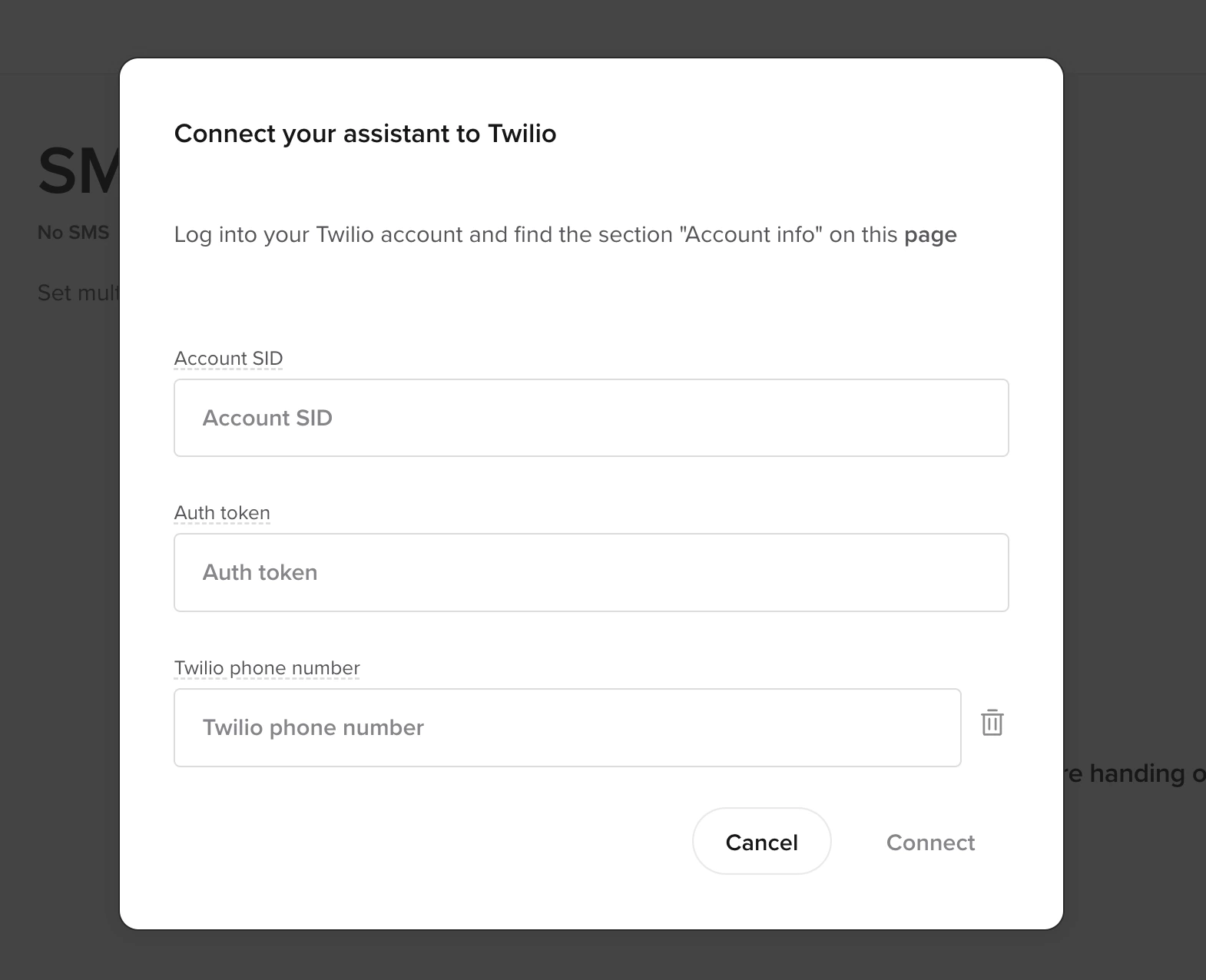
- Click Connect Twilio Account.
-
In the pop-up form, fill in the following fields:
- Account SID: Find this in the “Account Info” section of your Twilio dashboard.
- Auth Token: Retrieve this from your Twilio account settings.
- Twilio Phone Number: Provide the number you wish to use for sending SMS messages.
-
Click Connect to link your Twilio account.
A2P 10DLC registration (US and Canada)
If you are using a US or Canadian Twilio number, you must register for A2P 10DLC to comply with carrier regulations. Without registration, Twilio blocks SMS messages entirely.Register
- Go to Twilio’s A2P 10DLC registration page: Twilio A2P 10DLC Registration Guide
- Complete brand and campaign registration to comply with US and Canadian carrier regulations.
- Wait for approval. This typically takes several weeks. Twilio has become increasingly strict with approvals.
- Once approved, messages will send successfully.
Add SMS templates
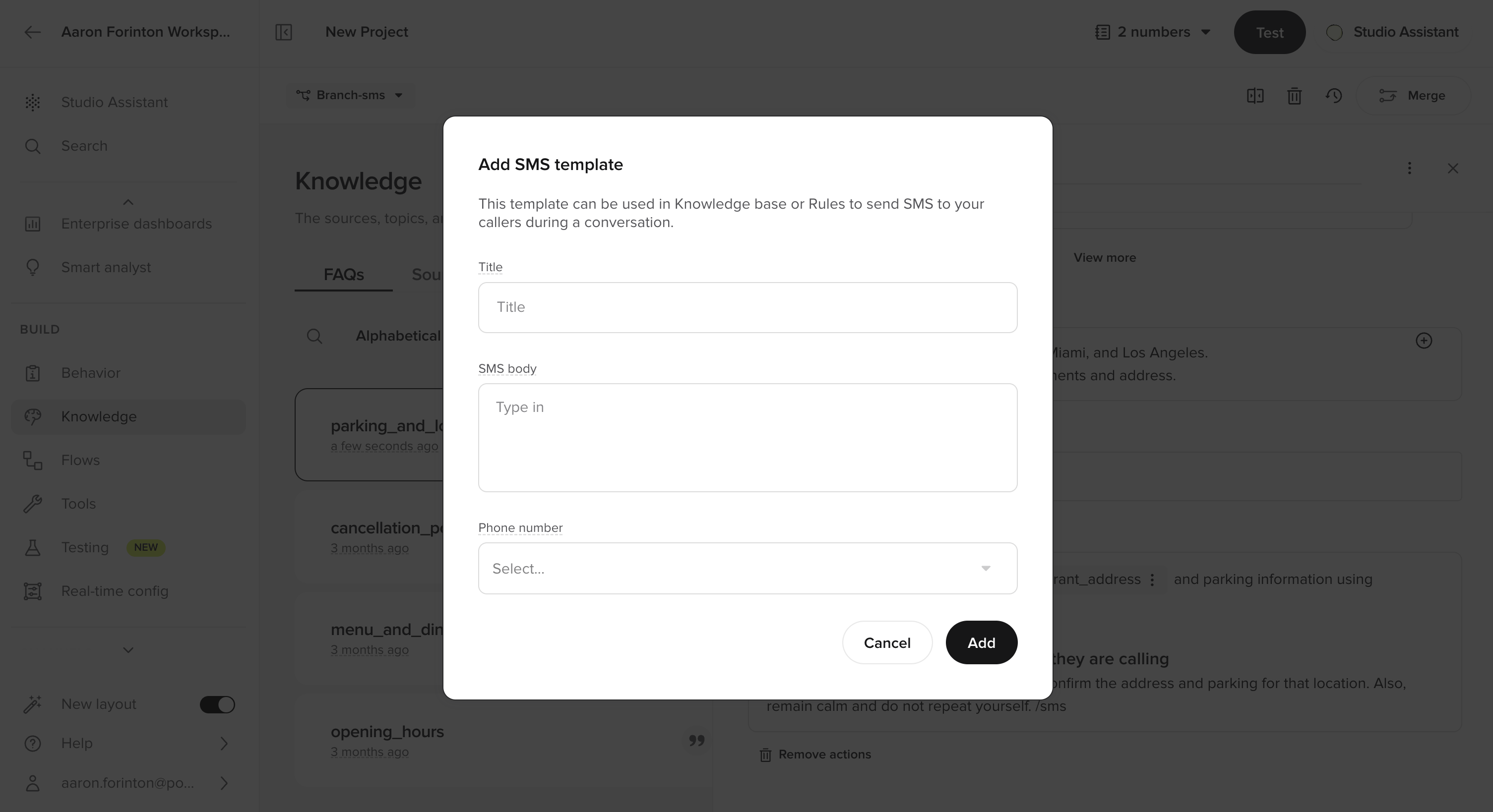
Once connected, follow these steps to create SMS templates:- Click Add SMS template (from the Message templates tab, or from Knowledge).
- Fill in the form:
- Title: A descriptive name for the SMS template (e.g.,
reservation_confirmation). This is the name shown in the insert menu’s SMS group and the name you reference when triggering the template in functions. Max 100 characters. - SMS Body: The content of the message. Max 500 characters. Supports dynamic tokens (see below).
- Phone Number: Choose the Twilio phone number associated with this message.
- Title: A descriptive name for the SMS template (e.g.,
- Save the template to make it available during conversations.
Per-environment phone numbers
Each SMS template can use a different Twilio phone number per environment, so you can test SMS in Sandbox with a test number while using a production number in Live. The phone number you select in the template form applies to the Live environment. Sandbox and Staging can be configured separately. This prevents test messages from being sent from your production number during development.Messaging Service IDs
In addition to phone numbers, you can use a Twilio Messaging Service ID (format:MG followed by 32 hex characters) instead of a direct phone number. Messaging Services let Twilio manage number selection, compliance, and scaling automatically, which works well for high-volume deployments.
Dynamic tokens
You can insert dynamic values into SMS templates using the following syntax:
Example template body:
confirmation_en, confirmation_es).
Managing templates
All created SMS templates are listed under Voice > Message templates. You can:- Edit: Modify the title, message content, or associated phone number.
- Duplicate: Quickly create a copy of an existing template for similar use cases.
- Delete: Remove unused or outdated templates.
Using an SMS template
-
Go to Knowledge > FAQs tab
- Ensure you are on the FAQs tab.
-
Add an action to a Managed Topic card
- In any Managed Topic card, click “Add Actions.”
-
Set SMS action
- Prompt something like “If someone asks for more details, send” in the action box.
- Open the insert menu (type
/, or click the + button on the right-hand side of the box) and choose your template from the SMS group.
- Click ‘Save’ and ‘Publish’
Compliance keywords (STOP, START, HELP)
PolyAI automatically handles the standard SMS compliance keywords required by TCPA and carrier rules. When a recipient replies with one of these keywords, PolyAI responds and updates their opt-out status without forwarding the message to your agent. Opt-out status is tracked per (recipient number, Twilio number) pair, so a user opted out of one campaign can still receive messages from a different Twilio number.Supported keywords
Matching is case-insensitive and ignores leading or trailing whitespace and a single trailing punctuation character (., !, ?, ,, ;). For example, stop, STOP., and Stop! are all treated as STOP.
Default reply messages
What this means for your agent
- Inbound
STOP/START/HELPreplies never reach your flows or FAQs. They are intercepted at the SMS handler, so you do not need to script keyword responses yourself. - Outbound SMS to opted-out recipients is silently dropped. If a function or Managed Topic action calls
conv.send_smsorconv.send_sms_templatefor an opted-out number, the request returns successfully but no SMS is delivered. Check the Self-serve dashboards SMS widget to monitor delivery. - Any other inbound message from an opted-out sender is also dropped until they reply
START. - The opt-out record persists indefinitely until the user opts back in, satisfying TCPA record-keeping requirements.
A2P 10DLC campaigns in the US and Canada require you to disclose
STOP and HELP behavior during opt-in. The replies above meet that requirement as-is.Best practices
- Keep messages short and relevant – 160 characters or fewer sends as a single segment.
- Use variant attributes or dynamic fields (e.g., customer name, booking details) to personalize messages.
- Disclose
STOPandHELPkeywords when collecting opt-in consent – PolyAI handles the replies automatically, but the disclosure is your responsibility.
Handing off an SMS conversation to a live agent
To escalate an SMS conversation to a human agent in your CCaaS or CRM, use a chat handoff integration. PolyAI proxies messages between the end user and the live agent for the rest of the session, so the user stays in the same SMS thread. Supported chat handoff integrations include Salesforce, Zendesk, NICE CXone, Amazon Connect, Genesys Cloud, and Webex by Cisco.Example: Triggering an SMS alongside a voice handoff
Combine a voice handoff with an outbound SMS:- The agent transfers the caller to a specific agent or team using Handoffs.
- At the same time, an SMS template is triggered, sending the user additional details or confirmation of the transfer.
Integrating SMS into a function
SMS can be triggered as part of a function using theconv object:
conv.send_sms
Sends a free-form SMS message to a specified phone number.
conv.send_sms_template
Sends a pre-configured SMS template by template name (the title you defined under Voice > Message templates).
prescription_refill, use conv.send_sms_template(conv.caller_number, 'prescription_refill').
Session timeouts
If an SMS conversation goes idle and the session times out due to inactivity, PolyAI sends a final notification SMS to the user before closing the session:Delivery and logging
- Successful SMS sends are logged in the conversation metadata.
- Failed sends increment the API Failures metric.
- Use the SMS widget on the Self-serve dashboards to monitor delivery rates.