

Multi-draft (Branches)
Multi-draft (Branches)
Agent Studio now supports multi-draft development using branches, allowing multiple people or teams to work on the same project in parallel without colliding.This is especially valuable for organisations that need to ship urgent fixes quickly while continuing longer-term feature work — without turning Sandbox into a single shared bottleneck.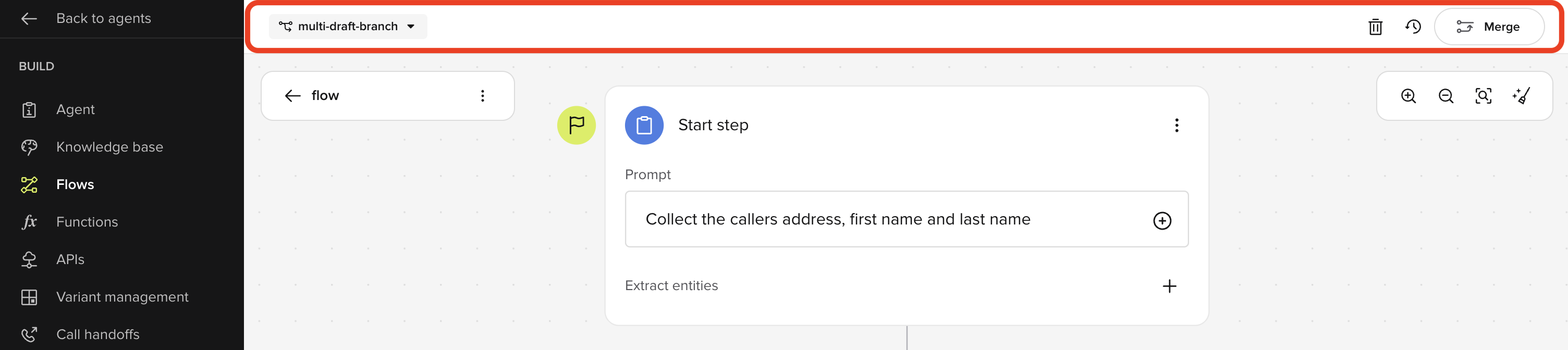
- Whenever you make a change, create branches from the main project so work can happen in parallel.
- Branches are listed under each project, with information like the owner, creation time, and last edited.
- Merge a branch back into the main project using Merge (replacing Publish).
- Built-in conflict resolution shows changes side-by-side (re-using the version comparison experience) and requires resolving all conflicts before merge.
No-code flows
No-code flows
No-code flows make it possible to build and evolve conversational logic without writing custom functions for every step.This lowers the barrier for external builders while still allowing advanced steps and functions where needed.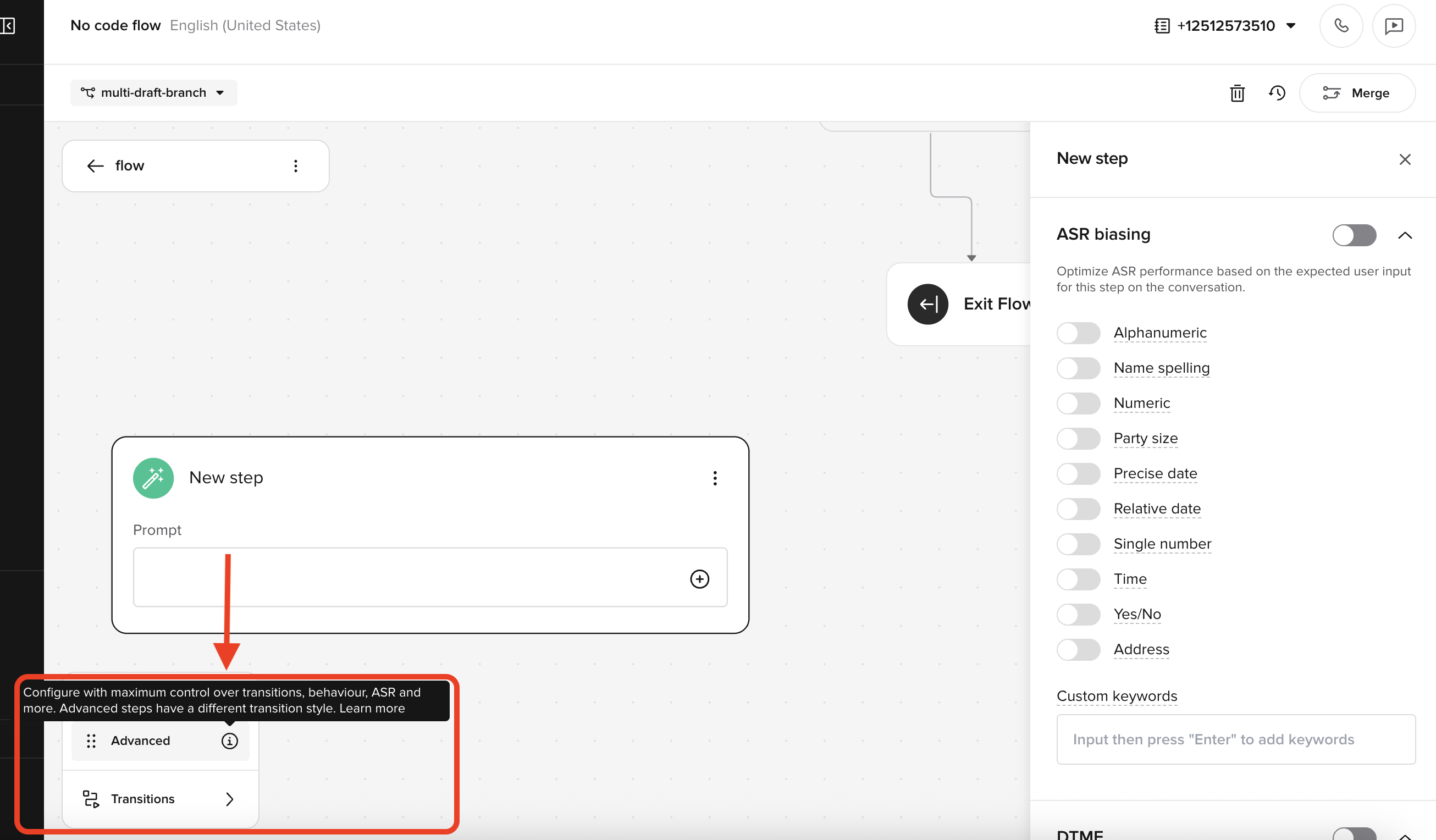
- Build flows using default nodes with instructions, entity collection, and conditional routing.
- Drag-and-drop connections between steps without writing transition functions.
- Combine no-code steps with advanced steps in the same flow for complex scenarios.
API integrations in Agent Studio
API integrations in Agent Studio
A new API integrations area lets you configure external endpoints directly in the UI — making API-backed agents easier to build and reuse.
- New API integrations page listing configured endpoints with name, operation, and description.
- Configure base URLs and authentication per environment (Sandbox / Pre-release / Live) while keeping operation details consistent.
- Supported auth types include No Auth, Basic Auth, API Key, and OAuth 2.0.
- Use variables inside headers and body fields for dynamic runtime values.
- Call configured APIs from functions using
conv.api(for example:conv.api.<integration>.<operation>(...)). - API request and response status can be surfaced in logs for debugging and QA review.
Variant info in Test Cases
Variant info in Test Cases
Test Cases can now show the variant they were saved against, so teams can reliably run QA against the correct configuration in variant-driven deployments.This matters in real builds because the same prompt running on the wrong variant is effectively a different agent.What’s new:
- Test Case list and detail pages now display the variant used when the test case was saved.
- The variant column only appears for projects that use variants.
- If a referenced variant has been deleted, the UI flags the test case so it can be updated or removed.
Conversation review & PolyScore enhancements
Conversation review & PolyScore enhancements
Conversation Review now provides clearer, more transparent signals about call quality and outcomes, making it easier to understand why a conversation succeeded or failed.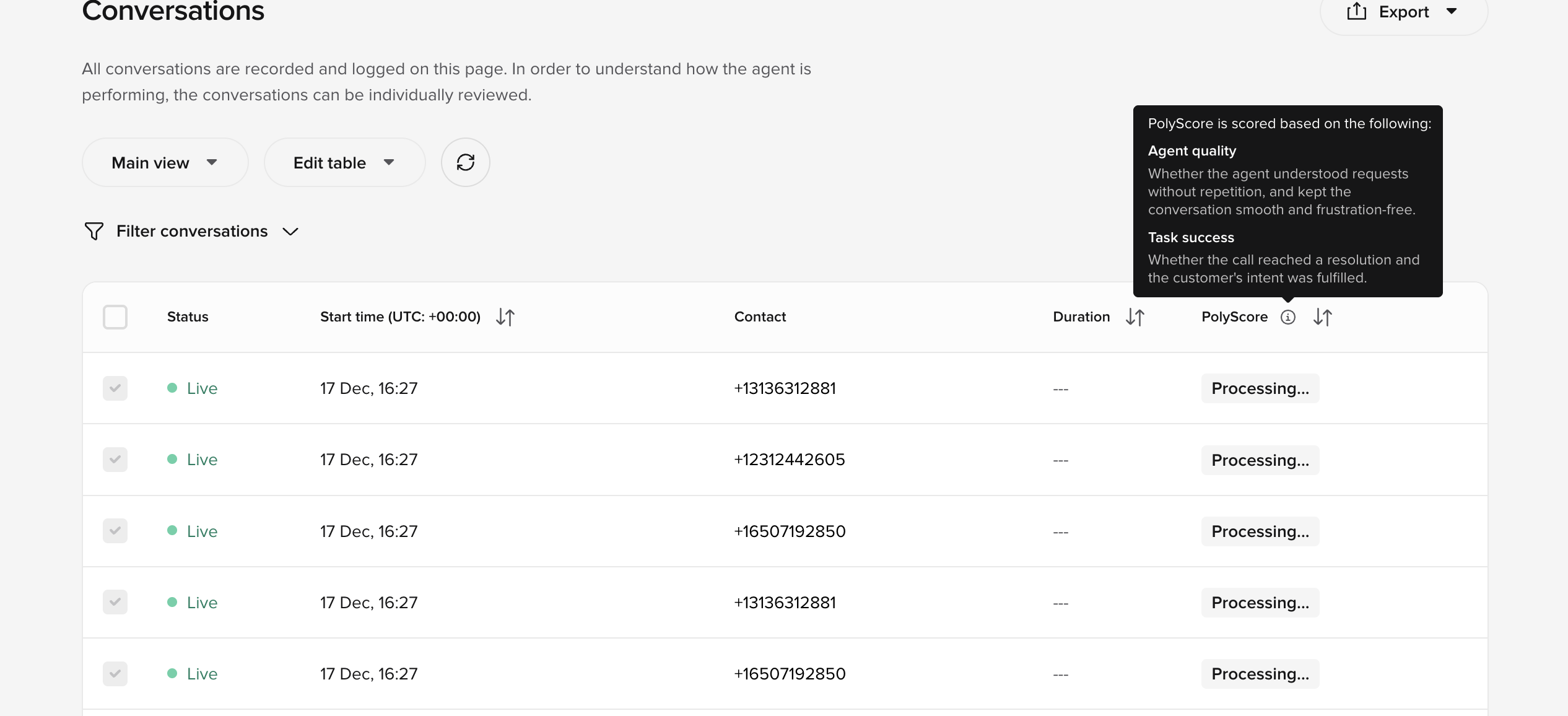
- Redesigned conversation table and review UI with clearer summaries and improved readability.
- PolyScore breakdowns now explain how scores are calculated, including:
- Agent understanding
- Task success and resolution quality
- Inline explanations and tooltips make scoring criteria explicit.
Smart Analyst live reasoning steps
Smart Analyst live reasoning steps
Smart Analyst now streams its reasoning steps live while an analysis is running, giving users immediate visibility into how conclusions are formed.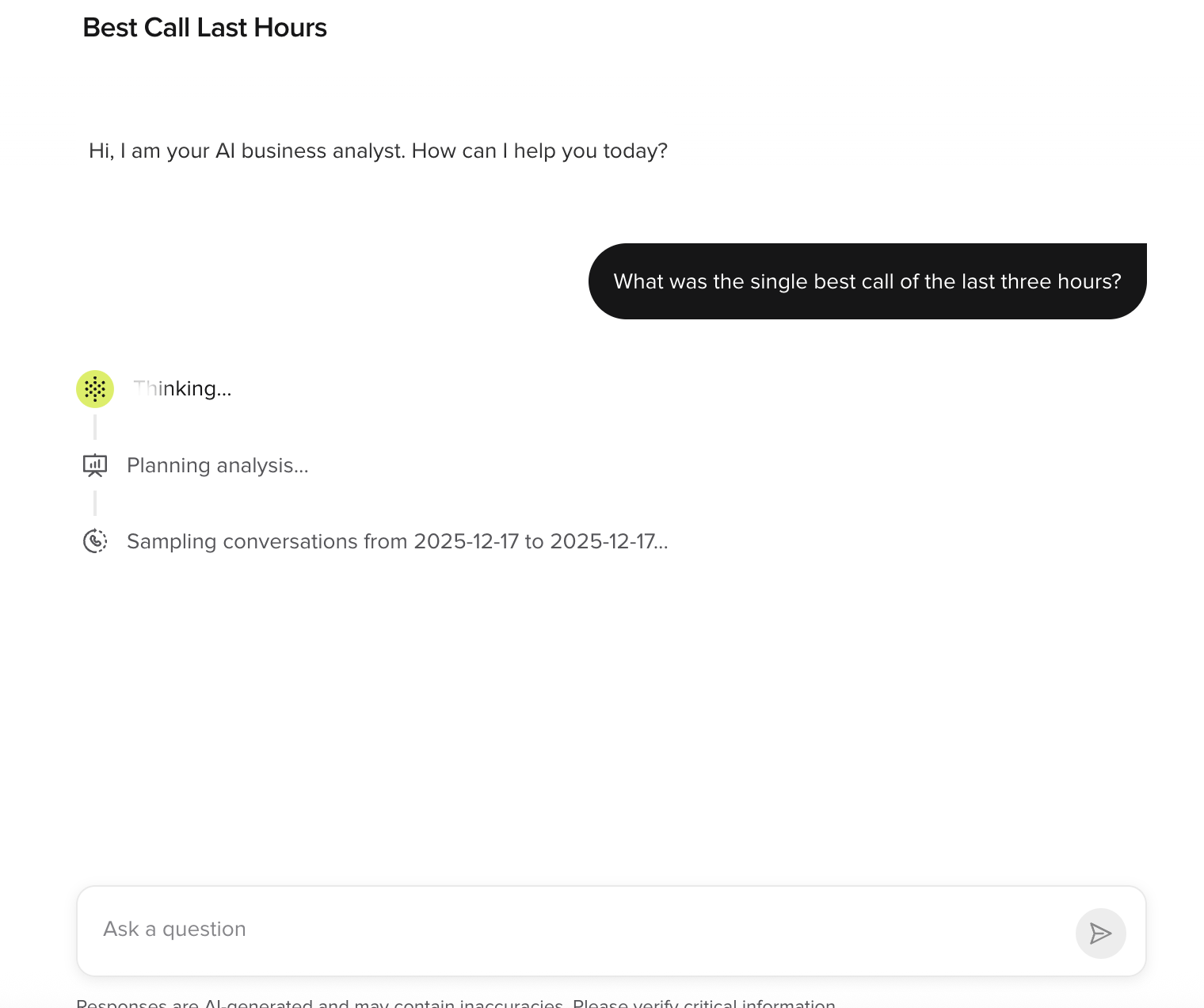
- Analysis stages are shown progressively.
- Users can follow the model’s thinking in real time, so complex analyses are faster and more transparent.