> ## Documentation Index
> Fetch the complete documentation index at: https://docs.poly.ai/llms.txt
> Use this file to discover all available pages before exploring further.
# Triggering flows
> Start flows from FAQs, global functions, or transition functions using conv.goto_flow().
**This page requires Python familiarity** for the programmatic examples. Non-technical operators can trigger flows from FAQs actions without writing code – see [Start a flow from a FAQs action](#start-a-flow-from-a-faqs-action) below. All code-focused content is also available in the **Developer** tab.
A flow starts when something calls `conv.goto_flow("Flow name")`. This may happen through a FAQs action or programmatically inside a function.
This page explains how `conv.goto_flow` can be used:
You can call `conv.goto_flow(...)` from any [function](/tools/introduction) in Agent Studio, including:
* A [FAQs action](/knowledge/faqs/actions/introduction)
* A [global function](/tools/classes/conv-object)
* A [transition function inside a flow](/flows/transition-functions)
Example:
```python theme={"theme":{"light":"github-light","dark":"github-dark"}}
def start_booking(conv: Conversation):
conv.goto_flow("Make a booking")
return
```
What happens:
* The function runs during the current turn.
* When the turn completes, the agent enters the named flow.
* The flow begins at its configured start step.
## Start a flow from a FAQs action
A Managed Topic can trigger a flow when it matches a user request. This is the primary way to collect [entities](/flows/no-code/entities) from a topic, since FAQs do not support entity extraction directly.
### Using the /Flow shortcut (no code)
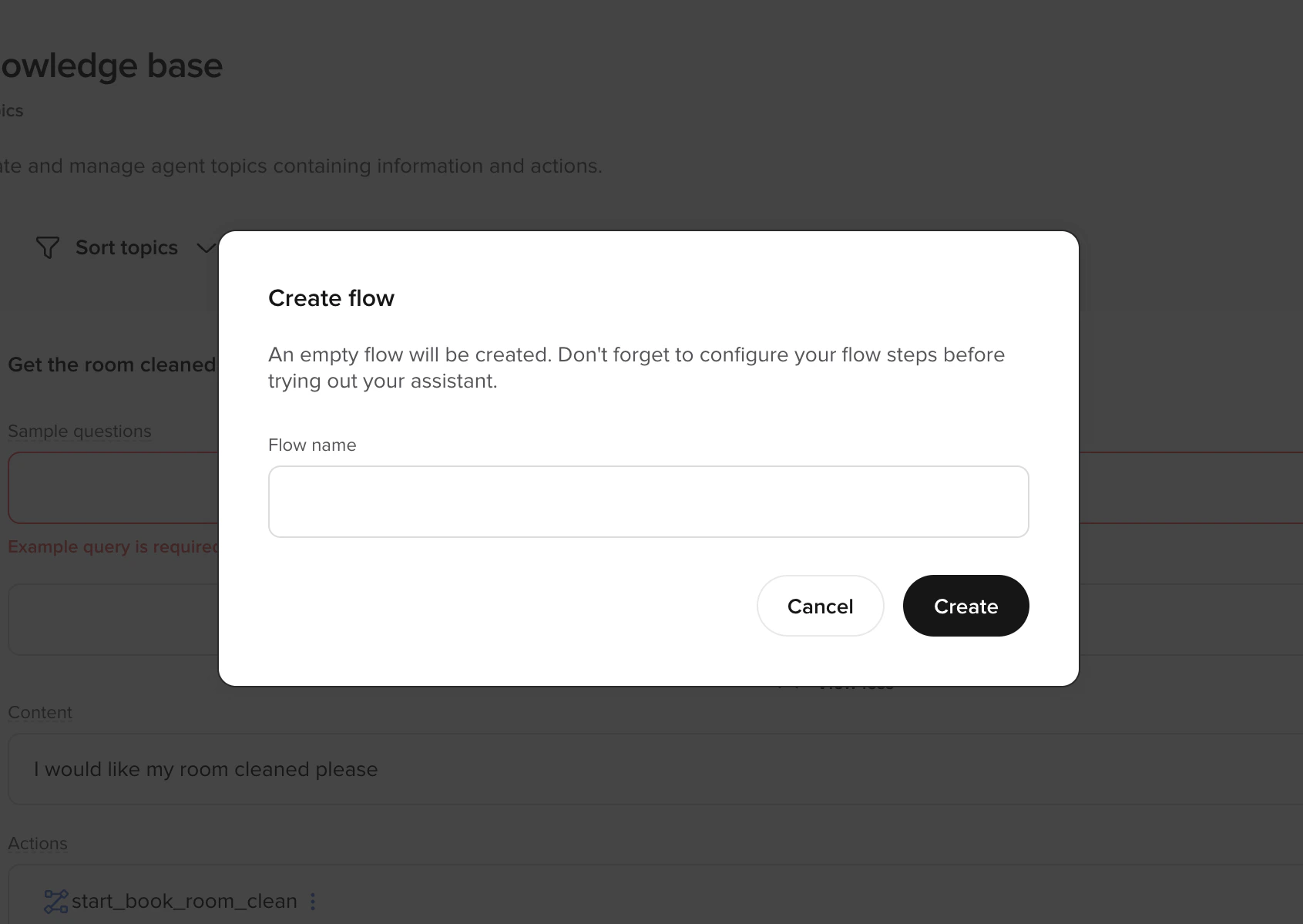 Inside a FAQs **Actions** field, type `/Flow` and use the (+) option to create or attach a flow. When the topic matches, the agent enters the selected flow at its start step.
No custom function is required if you just need to enter the flow.
### Using a tool call from a topic
If you need additional logic before entering the flow – for example, storing context so the agent can return to the topic afterward – use a tool call action instead:
```python theme={"theme":{"light":"github-light","dark":"github-dark"}}
def start_verification_flow(conv: Conversation, original_faq: str):
"""
Enter the verification flow and remember which topic we came from.
Args:
original_faq: the name of the topic that triggered this function
"""
conv.state.original_topic = original_faq
conv.goto_flow("Verify Identity")
return
```
You can also trigger a flow from a global function by calling `conv.goto_flow()` directly.
### Returning to a topic after a flow
When a topic triggers a flow (e.g. to collect a date or verify identity), the agent can return to the original topic content after the flow exits. To do this:
1. Before entering the flow, store the topic name in state (e.g. `conv.state.original_topic`).
2. In the flow's exit function, check the stored topic and return a prompt that directs the LLM to the relevant topic content:
**What is an "exit function"?** There is no special "exit function" step type. An exit function is just a [transition function](/flows/transition-functions) on the final step of the flow that calls `conv.exit_flow()` and returns a payload (typically `{"content": ...}` or `{"utterance": ...}`). It runs because the step runs — not because the flow registers an "on-exit hook" — and its return value becomes the function output the agent uses next. Mutating `conv.state` from inside it is the same as from any other function: `conv.state["is_verified"] = True` (or `conv.state.is_verified = True`) takes effect immediately and persists across subsequent turns.
```python theme={"theme":{"light":"github-light","dark":"github-dark"}}
def exit_and_resume(conv: Conversation, flow: Flow):
conv.exit_flow()
if conv.state.original_topic:
return {
"content": f"Look for the topic '{conv.state.original_topic}' in your context. "
f"Continue answering the caller's original question."
}
return {"utterance": "Is there anything else I can help with?"}
```
This pattern avoids a generic "Is there anything else?" when the caller's original question has not yet been answered.
### Common mistakes
`conv.goto_flow()` only **queues** a transition — it does not pause your function, run the target flow inline, and resume. The flow runs on subsequent turns. The following anti-patterns all stem from forgetting that.
**Anti-pattern: checking the verification result inline after `goto_flow()`.**
```python theme={"theme":{"light":"github-light","dark":"github-dark"}}
# Don't do this
def identify_and_verify_user(conv: Conversation, account_type: str):
if conv.state.is_verified == False:
conv.state.original_topic = "check_account_balance"
conv.goto_flow("Identify & Verify User")
# Nothing below runs as you'd expect:
# - The verification flow hasn't run yet (it runs next turn).
# - `verification_successful` is undefined.
# - The branch reading `conv.state.is_verified` runs against
# the value from BEFORE the flow.
if verification_successful:
conv.state.is_verified = True
return check_account_balance(conv, conv.state.pending_account_type)
```
**Why it fails**: `conv.goto_flow(...)` returns immediately and the rest of the function executes on the same turn — before the verification flow has had a chance to run. Any code that reads the result of the flow on the same call will see stale or undefined values.
**Correct pattern**: store context, call `conv.goto_flow(...)`, `return` — and resume in the flow's [exit function](/flows/transition-functions):
```python theme={"theme":{"light":"github-light","dark":"github-dark"}}
def identify_and_verify_user(conv: Conversation, account_type: str):
if not conv.state.get("is_verified"):
conv.state.pending_account_type = account_type
conv.state.original_topic = "check_account_balance"
conv.goto_flow("Identify & Verify User")
return "Tell the user we need to verify their identity first."
# Already verified — proceed with the original task
return check_account_balance(conv, account_type)
```
Inside the verification flow, its steps set `conv.state["is_verified"]` (and any other context). The flow's exit function reads that state and routes back:
```python theme={"theme":{"light":"github-light","dark":"github-dark"}}
def exit_and_resume(conv: Conversation, flow: Flow):
conv.exit_flow()
if conv.state.get("is_verified") and conv.state.get("original_topic") == "check_account_balance":
return {
"content": (
f"The caller has been verified. "
f"Resume the '{conv.state.original_topic}' topic "
f"with account_type='{conv.state.pending_account_type}'."
)
}
return {"utterance": "Tell the user we could not verify their identity."}
```
**Anti-pattern: `if conv.state.is_verified == False:`**
When `is_verified` has never been written, [`conv.state.is_verified` returns `None`](/tools/classes/conv-object#state), not `False`. `None == False` is `False`, so the guard is silently skipped and the unverified user falls through to the protected code.
```python theme={"theme":{"light":"github-light","dark":"github-dark"}}
# Don't do this — silently lets unverified callers through
if conv.state.is_verified == False:
...
# Do this — treats missing and falsy the same way
if not conv.state.get("is_verified"):
...
```
**Anti-pattern: mutual recursion between a protected function and its guard.**
```python theme={"theme":{"light":"github-light","dark":"github-dark"}}
# Don't do this
def check_account_balance(conv: Conversation, account_type: str):
if not conv.state.get("is_verified"):
return identify_and_verify_user(conv) # recurses; returns None on cold-start
...
def identify_and_verify_user(conv: Conversation):
if not conv.state.get("is_verified"):
conv.goto_flow("Identify & Verify User")
return "Tell the user we need to verify their identity first."
# Unreachable on the first call — the function above returned already
return check_account_balance(conv, conv.state.pending_account_type)
```
**Why it fails**: on the first (unverified) call, `identify_and_verify_user` queues `goto_flow` and returns a string — but execution never comes back into `check_account_balance` on this turn, so callers reading the return of `check_account_balance` get `None` or the verification string instead of a balance response.
**Correct pattern**: only the entry point calls `goto_flow` + `return`. Post-flow resumption is done in the target flow's exit function, not by calling the original function recursively.
## Preventing verification loops
A protected function that calls `conv.goto_flow("Identify & Verify User")` whenever `conv.state.is_verified` is falsy will keep sending the user back into verification — every turn, forever — unless two things are true:
* The verification flow writes `is_verified = True` on the success path.
* The protected function has a terminal branch for repeated failures.
Skip either one and the caller is trapped in the loop. The walkthrough below sets up both halves of the fix.
The entry point stores any context the flow will need on resume, calls `conv.goto_flow(...)`, and returns. It must not try to read the verification result on the same turn — `goto_flow` only queues the transition.
```python theme={"theme":{"light":"github-light","dark":"github-dark"}}
def check_account_balance(conv: Conversation, account_type: str):
if not conv.state.get("is_verified"):
conv.state.original_topic = "check_account_balance"
conv.state.pending_account_type = account_type
conv.goto_flow("Identify & Verify User")
return "Tell the user we need to verify their identity first."
...
```
Inside the verification flow, a transition function on the verification step compares user input to the expected value. On success it writes `is_verified = True`; on failure it increments an attempts counter and routes to escalation once the counter hits 3.
```python theme={"theme":{"light":"github-light","dark":"github-dark"}}
def check_verification(conv: Conversation, flow: Flow):
if conv.state.get("user_input") == conv.state.get("expected_value"):
conv.state.is_verified = True
flow.goto_step("Verification succeeded")
return
attempts = conv.state.get("verification_attempts", 0) + 1
conv.state.verification_attempts = attempts
if attempts >= 3:
conv.goto_flow("Escalation")
return
flow.goto_step("Retry verification")
return
```
Without the success-path write, the protected function's `is_verified` check stays falsy and the loop repeats on every turn.
Even with the flow setting `is_verified` correctly, the caller still needs its own guard on the attempts counter. Otherwise a user who fails three times and then returns to the original topic re-triggers verification a fourth time.
```python theme={"theme":{"light":"github-light","dark":"github-dark"}}
def check_account_balance(conv: Conversation, account_type: str):
if conv.state.get("verification_attempts", 0) >= 3:
return "Tell the user we cannot continue without successful identity verification."
if not conv.state.get("is_verified"):
conv.state.original_topic = "check_account_balance"
conv.state.pending_account_type = account_type
conv.goto_flow("Identify & Verify User")
return "Tell the user we need to verify their identity first."
...
```
For the in-flow version of the same escalation pattern — when the failure happens inside a flow rather than at a protected entry point — see [Escalating after repeated failed verification](#example-escalating-after-repeated-failed-verification) below.
## Start or switch flows from inside another flow
Once a user is inside a flow, most movement should happen using `flow.goto_step(...)`.
That keeps the user inside the same workflow and branches to another step.
However, sometimes you need to switch to an entirely different workflow.
Examples:
* The user fails identity verification and must enter a verification flow.
* The user requests a human agent and must enter an escalation flow.
* A compliance rule requires a separate structured process.
* The user changes intent entirely (e.g., from booking to cancellation).
In these cases, start a new flow instead of branching.
You do this by calling `conv.goto_flow("Flow name")` from a function inside the current flow.
### Example: Escalating after repeated failed verification
Imagine a booking flow where the user must confirm their date of birth.
If they fail verification too many times, you want to move them into a dedicated verification flow.
```python theme={"theme":{"light":"github-light","dark":"github-dark"}}
def check_verification(conv: Conversation, flow: Flow):
attempts = conv.state.verification_attempts or 0
if not conv.state.is_verified:
attempts += 1
conv.state.verification_attempts = attempts
if attempts >= 3:
conv.goto_flow("Identity Verification")
return
flow.goto_step("Retry verification")
return
flow.goto_step("Continue booking")
return
```
Inside a function, only the last `flow.goto_step(...)` call is executed
## Routing based on API results
**Main article**: [`conv.api`](/tools/classes/conv-api)
A function may call an API using `conv.api`.
After receiving a response, explicitly choose one of two actions:
* Stay in the current workflow using `flow.goto_step(...)`
* Switch workflows using `conv.goto_flow(...)`
Example:
```python theme={"theme":{"light":"github-light","dark":"github-dark"}}
def check_customer_status(conv: Conversation, flow: Flow):
response = conv.api.crm.lookup_user(id=conv.state.user_id)
if response.status_code != 200:
flow.goto_step("API error handling")
return
data = response.json()
if data.get("status") == "requires_verification":
conv.goto_flow("Verification flow")
return
flow.goto_step("Continue booking")
return
```
## Next steps
Understand how flows work and the available trigger methods.
Control routing logic with Python inside flow steps.
Python reference for goto\_step() and current\_step.
Inside a FAQs **Actions** field, type `/Flow` and use the (+) option to create or attach a flow. When the topic matches, the agent enters the selected flow at its start step.
No custom function is required if you just need to enter the flow.
### Using a tool call from a topic
If you need additional logic before entering the flow – for example, storing context so the agent can return to the topic afterward – use a tool call action instead:
```python theme={"theme":{"light":"github-light","dark":"github-dark"}}
def start_verification_flow(conv: Conversation, original_faq: str):
"""
Enter the verification flow and remember which topic we came from.
Args:
original_faq: the name of the topic that triggered this function
"""
conv.state.original_topic = original_faq
conv.goto_flow("Verify Identity")
return
```
You can also trigger a flow from a global function by calling `conv.goto_flow()` directly.
### Returning to a topic after a flow
When a topic triggers a flow (e.g. to collect a date or verify identity), the agent can return to the original topic content after the flow exits. To do this:
1. Before entering the flow, store the topic name in state (e.g. `conv.state.original_topic`).
2. In the flow's exit function, check the stored topic and return a prompt that directs the LLM to the relevant topic content:
**What is an "exit function"?** There is no special "exit function" step type. An exit function is just a [transition function](/flows/transition-functions) on the final step of the flow that calls `conv.exit_flow()` and returns a payload (typically `{"content": ...}` or `{"utterance": ...}`). It runs because the step runs — not because the flow registers an "on-exit hook" — and its return value becomes the function output the agent uses next. Mutating `conv.state` from inside it is the same as from any other function: `conv.state["is_verified"] = True` (or `conv.state.is_verified = True`) takes effect immediately and persists across subsequent turns.
```python theme={"theme":{"light":"github-light","dark":"github-dark"}}
def exit_and_resume(conv: Conversation, flow: Flow):
conv.exit_flow()
if conv.state.original_topic:
return {
"content": f"Look for the topic '{conv.state.original_topic}' in your context. "
f"Continue answering the caller's original question."
}
return {"utterance": "Is there anything else I can help with?"}
```
This pattern avoids a generic "Is there anything else?" when the caller's original question has not yet been answered.
### Common mistakes
`conv.goto_flow()` only **queues** a transition — it does not pause your function, run the target flow inline, and resume. The flow runs on subsequent turns. The following anti-patterns all stem from forgetting that.
**Anti-pattern: checking the verification result inline after `goto_flow()`.**
```python theme={"theme":{"light":"github-light","dark":"github-dark"}}
# Don't do this
def identify_and_verify_user(conv: Conversation, account_type: str):
if conv.state.is_verified == False:
conv.state.original_topic = "check_account_balance"
conv.goto_flow("Identify & Verify User")
# Nothing below runs as you'd expect:
# - The verification flow hasn't run yet (it runs next turn).
# - `verification_successful` is undefined.
# - The branch reading `conv.state.is_verified` runs against
# the value from BEFORE the flow.
if verification_successful:
conv.state.is_verified = True
return check_account_balance(conv, conv.state.pending_account_type)
```
**Why it fails**: `conv.goto_flow(...)` returns immediately and the rest of the function executes on the same turn — before the verification flow has had a chance to run. Any code that reads the result of the flow on the same call will see stale or undefined values.
**Correct pattern**: store context, call `conv.goto_flow(...)`, `return` — and resume in the flow's [exit function](/flows/transition-functions):
```python theme={"theme":{"light":"github-light","dark":"github-dark"}}
def identify_and_verify_user(conv: Conversation, account_type: str):
if not conv.state.get("is_verified"):
conv.state.pending_account_type = account_type
conv.state.original_topic = "check_account_balance"
conv.goto_flow("Identify & Verify User")
return "Tell the user we need to verify their identity first."
# Already verified — proceed with the original task
return check_account_balance(conv, account_type)
```
Inside the verification flow, its steps set `conv.state["is_verified"]` (and any other context). The flow's exit function reads that state and routes back:
```python theme={"theme":{"light":"github-light","dark":"github-dark"}}
def exit_and_resume(conv: Conversation, flow: Flow):
conv.exit_flow()
if conv.state.get("is_verified") and conv.state.get("original_topic") == "check_account_balance":
return {
"content": (
f"The caller has been verified. "
f"Resume the '{conv.state.original_topic}' topic "
f"with account_type='{conv.state.pending_account_type}'."
)
}
return {"utterance": "Tell the user we could not verify their identity."}
```
**Anti-pattern: `if conv.state.is_verified == False:`**
When `is_verified` has never been written, [`conv.state.is_verified` returns `None`](/tools/classes/conv-object#state), not `False`. `None == False` is `False`, so the guard is silently skipped and the unverified user falls through to the protected code.
```python theme={"theme":{"light":"github-light","dark":"github-dark"}}
# Don't do this — silently lets unverified callers through
if conv.state.is_verified == False:
...
# Do this — treats missing and falsy the same way
if not conv.state.get("is_verified"):
...
```
**Anti-pattern: mutual recursion between a protected function and its guard.**
```python theme={"theme":{"light":"github-light","dark":"github-dark"}}
# Don't do this
def check_account_balance(conv: Conversation, account_type: str):
if not conv.state.get("is_verified"):
return identify_and_verify_user(conv) # recurses; returns None on cold-start
...
def identify_and_verify_user(conv: Conversation):
if not conv.state.get("is_verified"):
conv.goto_flow("Identify & Verify User")
return "Tell the user we need to verify their identity first."
# Unreachable on the first call — the function above returned already
return check_account_balance(conv, conv.state.pending_account_type)
```
**Why it fails**: on the first (unverified) call, `identify_and_verify_user` queues `goto_flow` and returns a string — but execution never comes back into `check_account_balance` on this turn, so callers reading the return of `check_account_balance` get `None` or the verification string instead of a balance response.
**Correct pattern**: only the entry point calls `goto_flow` + `return`. Post-flow resumption is done in the target flow's exit function, not by calling the original function recursively.
## Preventing verification loops
A protected function that calls `conv.goto_flow("Identify & Verify User")` whenever `conv.state.is_verified` is falsy will keep sending the user back into verification — every turn, forever — unless two things are true:
* The verification flow writes `is_verified = True` on the success path.
* The protected function has a terminal branch for repeated failures.
Skip either one and the caller is trapped in the loop. The walkthrough below sets up both halves of the fix.
The entry point stores any context the flow will need on resume, calls `conv.goto_flow(...)`, and returns. It must not try to read the verification result on the same turn — `goto_flow` only queues the transition.
```python theme={"theme":{"light":"github-light","dark":"github-dark"}}
def check_account_balance(conv: Conversation, account_type: str):
if not conv.state.get("is_verified"):
conv.state.original_topic = "check_account_balance"
conv.state.pending_account_type = account_type
conv.goto_flow("Identify & Verify User")
return "Tell the user we need to verify their identity first."
...
```
Inside the verification flow, a transition function on the verification step compares user input to the expected value. On success it writes `is_verified = True`; on failure it increments an attempts counter and routes to escalation once the counter hits 3.
```python theme={"theme":{"light":"github-light","dark":"github-dark"}}
def check_verification(conv: Conversation, flow: Flow):
if conv.state.get("user_input") == conv.state.get("expected_value"):
conv.state.is_verified = True
flow.goto_step("Verification succeeded")
return
attempts = conv.state.get("verification_attempts", 0) + 1
conv.state.verification_attempts = attempts
if attempts >= 3:
conv.goto_flow("Escalation")
return
flow.goto_step("Retry verification")
return
```
Without the success-path write, the protected function's `is_verified` check stays falsy and the loop repeats on every turn.
Even with the flow setting `is_verified` correctly, the caller still needs its own guard on the attempts counter. Otherwise a user who fails three times and then returns to the original topic re-triggers verification a fourth time.
```python theme={"theme":{"light":"github-light","dark":"github-dark"}}
def check_account_balance(conv: Conversation, account_type: str):
if conv.state.get("verification_attempts", 0) >= 3:
return "Tell the user we cannot continue without successful identity verification."
if not conv.state.get("is_verified"):
conv.state.original_topic = "check_account_balance"
conv.state.pending_account_type = account_type
conv.goto_flow("Identify & Verify User")
return "Tell the user we need to verify their identity first."
...
```
For the in-flow version of the same escalation pattern — when the failure happens inside a flow rather than at a protected entry point — see [Escalating after repeated failed verification](#example-escalating-after-repeated-failed-verification) below.
## Start or switch flows from inside another flow
Once a user is inside a flow, most movement should happen using `flow.goto_step(...)`.
That keeps the user inside the same workflow and branches to another step.
However, sometimes you need to switch to an entirely different workflow.
Examples:
* The user fails identity verification and must enter a verification flow.
* The user requests a human agent and must enter an escalation flow.
* A compliance rule requires a separate structured process.
* The user changes intent entirely (e.g., from booking to cancellation).
In these cases, start a new flow instead of branching.
You do this by calling `conv.goto_flow("Flow name")` from a function inside the current flow.
### Example: Escalating after repeated failed verification
Imagine a booking flow where the user must confirm their date of birth.
If they fail verification too many times, you want to move them into a dedicated verification flow.
```python theme={"theme":{"light":"github-light","dark":"github-dark"}}
def check_verification(conv: Conversation, flow: Flow):
attempts = conv.state.verification_attempts or 0
if not conv.state.is_verified:
attempts += 1
conv.state.verification_attempts = attempts
if attempts >= 3:
conv.goto_flow("Identity Verification")
return
flow.goto_step("Retry verification")
return
flow.goto_step("Continue booking")
return
```
Inside a function, only the last `flow.goto_step(...)` call is executed
## Routing based on API results
**Main article**: [`conv.api`](/tools/classes/conv-api)
A function may call an API using `conv.api`.
After receiving a response, explicitly choose one of two actions:
* Stay in the current workflow using `flow.goto_step(...)`
* Switch workflows using `conv.goto_flow(...)`
Example:
```python theme={"theme":{"light":"github-light","dark":"github-dark"}}
def check_customer_status(conv: Conversation, flow: Flow):
response = conv.api.crm.lookup_user(id=conv.state.user_id)
if response.status_code != 200:
flow.goto_step("API error handling")
return
data = response.json()
if data.get("status") == "requires_verification":
conv.goto_flow("Verification flow")
return
flow.goto_step("Continue booking")
return
```
## Next steps
Understand how flows work and the available trigger methods.
Control routing logic with Python inside flow steps.
Python reference for goto\_step() and current\_step.